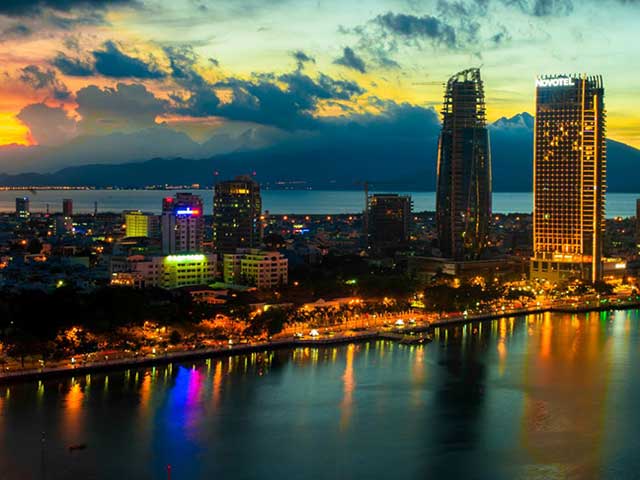
Halong Bay, Vietnam

Halong bay, Vietnam

Ha Long Bay is a UNESCO World Heritage Site, and a popular travel destination, located in Quang Ninh province, Vietnam. Administratively, the bay belongs to Hạ Long City, Cẩm Phả town, and part of Van Don district

Mt.Phousi, Luang Prabang, Laos

The Phousi Mountain (Luang Prabang)

The Phousi Mountain is situated in the centre of Luang Prabangs. To climb up the mountain can be hard but it is definitely worth the trip. There is a formidable view from the top of the mountain where you can see "The Royal Palace", and the surrounding rivers and villages.

Angkor Wat, Cambodia

Angkor Wat, Cambodia

Angkor Wat is the largest Hindu temple complex and the largest religious monument in the world.

Shwedagon Pagoda, Burma

Shwedagon Pagoda, Burma

The Shwedagon Pagoda officially titled Shwedagon Zedi Daw, also known in English as the Great Dagon Pagoda and the Golden Pagoda, is a 99 metres gilded pagoda and stupa located in Yangon, Burma.

Thien Mu pagoda

Thien Mu pagoda, Vietnam

Thien Mu Pagoda is a historic temple in the city of Huế in Vietnam. Its pagoda has seven storeys and is the tallest in Vietnam.

Showing posts with label Vietnam. Show all posts

Mar 16, 2019

Guide to visiting Vietnam Golden Bridge (Hand Giant Bridge) at Ba Na hills


Vietnam Golden Bridge, also known as Giant Hand Bridge or Cau Vang in Vietnamese, has recently gone viral across the world since it was first unveiled to the public in June 2018. It is the latest attraction at the Sun World Ba Na Hills fantasy amusement park. Follow us to check out what are best attractions at the Golden Bridge Ba Na Hills and How & When to get there for the unrivaled photo shoot?    

Where is the Golden Hand Bridge?

Da Nang city in Vietnam is well-known among Vietnam as the city of bridges with many impressive bridges along the Han River. And the Golden Bridge is the youngest one added to Da Nang’s bridge collection, yet it soon has become an unmissable symbol of Da Nang and a highlight of the Da Nang tour.
Location: Golden Bridge is located in Thien Thai Garden of Sun World Ba Na Hills.
Ba Na Hills, 35 kilometers southeast from Da Nang, is a famous hill station and resort. Unlike normal stations built on the ground, Ba Na Hills is located 1,489 meters high on Nui Chua Mountain.
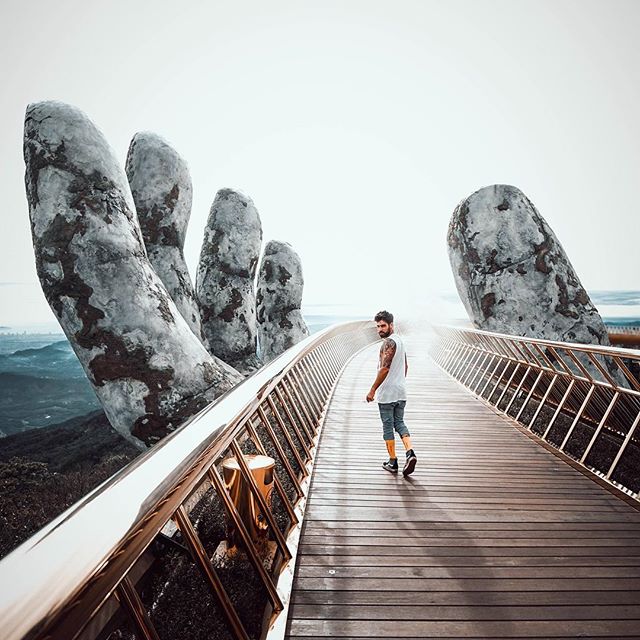
Threeland-Golden_bridge_in_Vietnam
Photo: Instagram @talrevivo
The bridge is 150 meters in length and 12.8 meters in width with 8 apertures of which the longest one is 21.2 meters. What impresses the travelers the most is the giant hand covered with moss lifting the bridge from the verdant hill. According to TA Landscape Architecture – the company that designed the bridge, the giant hand alludes to the mountain god, and the bridge represents the yellow silk that instructs the villagers to find Thien Thai garden. (Thien Thai means the Heaven)

How to get to the Golden bridge Vietnam?

The Golden Bridge is on the top of a mountain in Ba Na Hills and is only accessible by cable car. The cable cars all run from Sun World, meaning the only way to get to the bridge is by buying a ticket to visit Sun World (a franchise of theme parks in Vietnam).

Transportation mode from Da Nang center/Hoi An to Ba Na Hills foot:

It is a 40 minutes drive from Da Nang city center or one hour from Hoi An and pretty straight forward to get to. Some transportation mode from Da Nang city to Ba Na hill foot:
  • By motorbike:
The condition of the road is excellent and they are relatively quiet, so you could ride a motorbike to Sun World from Da Nang or Hoi An. You can’t get bored during one hour drive to Ba Na hill as there would be many marvelous sceneries of long beach, verdant jungle, local life along the road to admire.
You can hire a motorbike at your hotel at a very reasonable price – about 80,000 VND (3.44 USD) to 150,000 VND (6.45 USD) for a day.
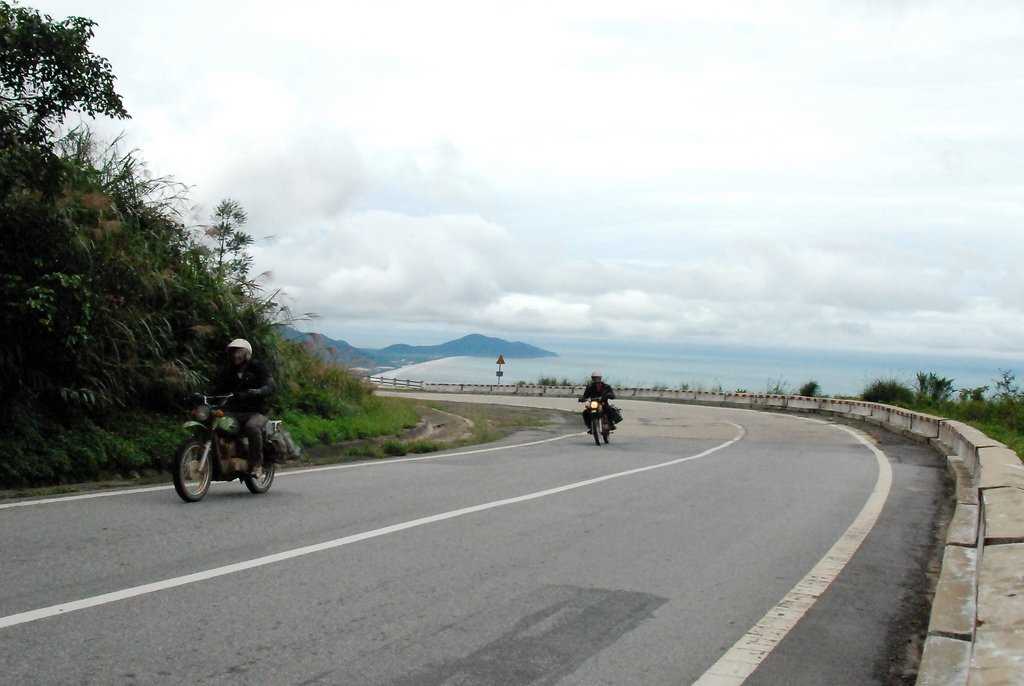
road_to_bana_hill_the_golden_bridge_Vietnam
Photo: Road to Bana Hills foot
  • By shuttle bus:
The shuttle bus from Da Nang center to the Ba Na Hills foot runs in the morning from 8am and returns to Da Nang in the afternoon with latest one at 4:30pm, with drop-off and pick-up at your hotel. This is a good option for those who can’t ride motorbike yet also want to save money. The price ranges from 120,000 VND to 150,000 VND for a two-way ticket and 100,000 VND for a one-way ticket. You can call the bus office to book the tickets or ask your hotel to book for you
Shuttle Bus contact:
Da Nang Xanh: 0511 247 555 or 0511 650 6789
Da Thanh Travel: 0236 263 8638 or 0905 516 026 or 0905 516 026
City Tour Da Nang: 0905 777 229 or 0935 434 335
Fewer shuttle buses operate from Hoi An to Ba Na Hills foot, but you will still be able to find a great deal at the travel agents around Hoi An. Price is supposed to be around 200,000 to 250,000 VND ($8.50 to $10.90 USD) per person for a return ticket.
  • By taxi:
The price from the center of Da Nang to Ba Na Hills foot ranges from 350,000 VND to 500,000 VND each way, depending on the type of taxi. You can go with your team to save money.
Some reliable taxi company in Da Nang:
Vinasun taxi: 0236 368 6868
Mai Linh taxi: 0236 356 5656
Tien Sa taxi: 0236 379 7979
  • By Private transfer 
Many trusty car rentals in Da Nang can offer you private care for rent or private transfer service upon your wish. With this option, it’s worry-free and more time for you to explore all attractions around the Golden Bridge.
  • Book a joining or private tour
By joining a tour, they will take care all for you from transport from your hotel to the Ba Na Hills, entrance (cable car) fee, lunch and a guided tour of some of the Ba Na Hills’ most sought-after attractions. With a tour guide, your trip should be more interesting with many stories about the city and the local’s lives here.

Board on the cable car to get to the Golden Bridge:

Once arrived at the foot of the Ba Na Hills, proceed through the entrance to purchase a ticket for the park. The Golden Bridge is located on top of Ba Na Hills, so cable car is the only way to reach it. Ticket prices are 750,000 VND ($33 USD) for an adult and 600,000 VND ($26.50 USD) for a child between 1m and 1.3m in height. Walk through to the Hoi An Station, where the longest cable car (over 5km) in the world awaits.
Queue for the pod and step in when it arrives. The cable car is about 17 minutes and arrives at the ‘Marseilles Station’. Along the way, it passes above gorgeous verdant scenery and provides excellent views down below to Da Nang’s My Khe Beach and the urban expanse of the city. 
Note: The entrance ticket includes most of the service in Ba Na Hills park: round-trip cable car, the Golden Bridge, French village, Fantasy Park, Linh Ung Pagoda on the mountain, Debay Wine Cellar the Le Jardin D’Amour Flower Garden.
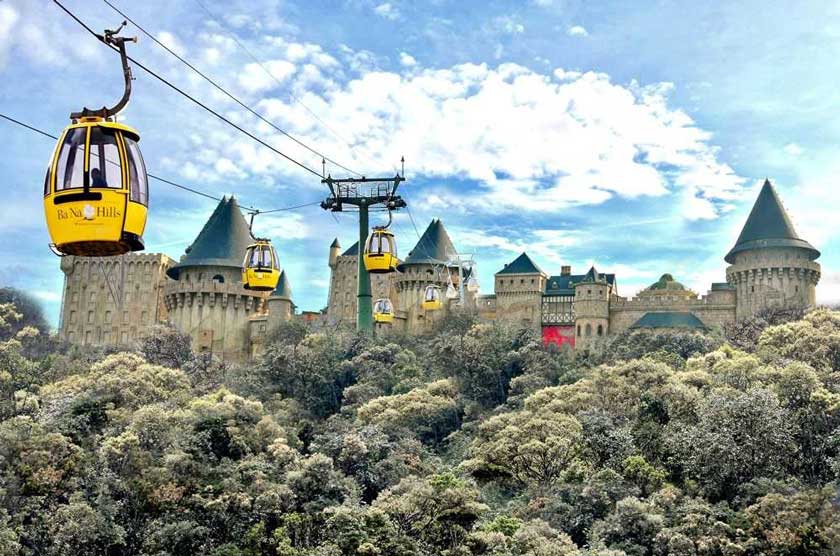
cable_car_at_bana_hill to golden bridge
Photo: Cable car to Ba Na Hills
From the circular arrival room of the Marseilles Station, you can exit directly onto the Golden Bridge and begin your walk along its 150 metres of wooden walkways, flanked by lavender and coated from the bottom and the handrails in a royal gold. As soon as you walk out the cable car’s doors you’ll realise that they couldn’t have picked a better spot.

Time to visit the Golden Bridge in Vietnam?

Timing is everything with the Golden Bridge and every minute counts. You can never tell what the weather will be. Even if it’s clear on the ground, the bridge can be surrounded by clouds and fogs.
If you desire to have the best shoot with fewer people on the bridge, then you’d better be on the first cable car at 7am. Although the early morning may have mist which actually made it more atmospheric, you still could see clear skies later. It really is worth it to set your alarm and go early, let the photos do the talking…..
It’s safe to say that this is one of the most crowded places to visit in Vietnam, especially at the weekend and during the peak tourism season from April to September. 
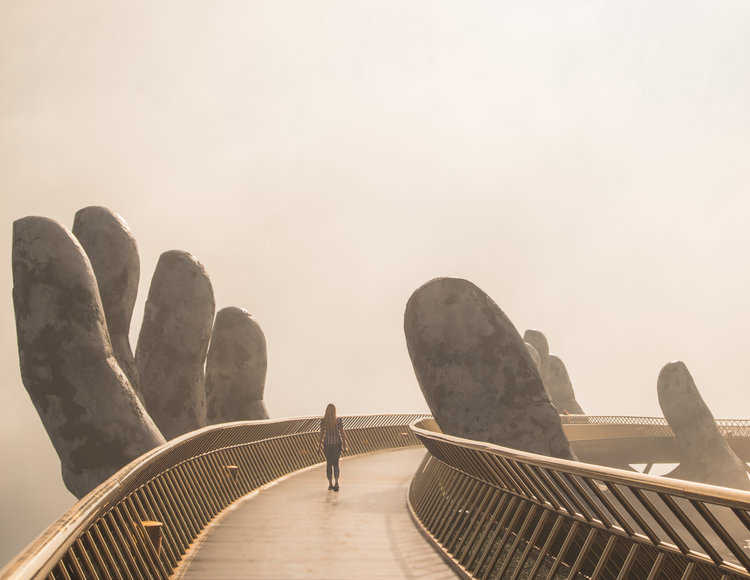
the_golden_bridge_in_Vietnam_in_early_morning
Photo: The bridge at 7.15am – Photo: walkmyworld
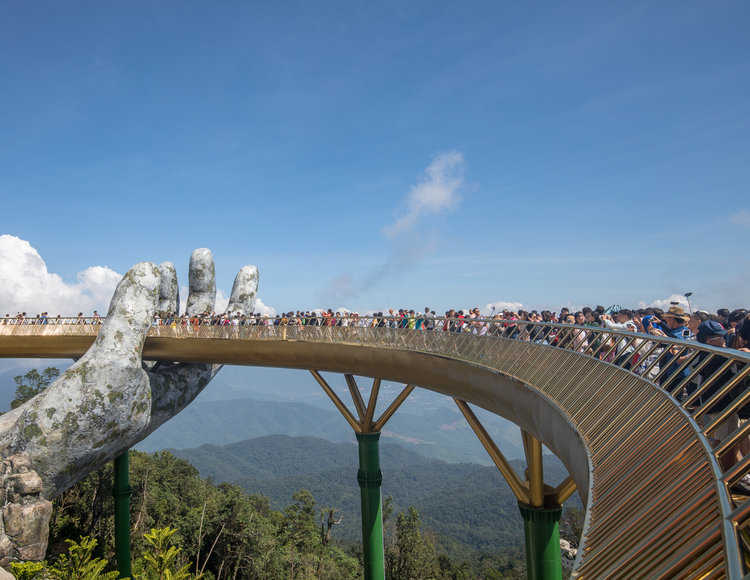
golden bridge
Photo: And 9am
Those who don’t fancy making such an early start can stay overnight in the heart of Ba Na Hills. The Mercure French Village is set in a section of the theme park that is only a very short cable car away from the Golden Bridge. Plenty of restaurants available around the hotel as well.

Tips for travel to the Golden Bridge in Vietnam:

  • Tickets are available only on the day you book.
  • The ticket includes activities such as cable car, the train ride, the garden, the wine cellar, the French village, and almost every game in the Fantasy Park for guests to explore and enjoy.
  • The first cable car is at 7 AM and the last one is at 9 PM.
  • It takes you about 6 hours to fully discover Ba Na Hills.
  • Bring a light jacket and an umbrella in case needed. 

Jan 26, 2015

Weather in Vietnam

Vietnam has a tropical monsoon climate. Broadly speaking, the weather in Vietnam is dictated by two seasons -- the southwest monsoon from April to September and the northeast monsoon from October to late March or early April.

People often equate monsoons with rain, but that is only partly the case in Vietnam, as a number of regional variations affect the rain. What is worth remembering though is the southwest monsoon is warm and wet and the northeast monsoon cool and not so wet.
As far as planning goes, the easiest way to get your head around it is to break up the country into three areas -- the north, the centre and the south. Temperatures are fairly constant throughout, with the exception of Hanoi and the far north (which can be very cold in December and January) and the Central Highlands (which can be slightly cooler than the rest of the country year-round).
Northern Vietnam has a cool to cold season (courtesy of the northeast monsoon from November to March) and a warm to hot wet season (from April to October). December and January in particular can get quite frosty in the far north of Vietnam -- pack accordingly. This time of the year can also see heavy mists that can run for days -- these can reduce visibility in places like Sapa and Ha Long Bay to frustratingly short distances. The wettest months of the year in Hanoi are July and August, the driest, December and January.
Central Vietnam is kind of a transitionary area climate-wise from the north to the south. As the coast line is shielded by the Truong Son mountain range the rains that come with the southwest monsoon don't make it to the coast, so between April and September, while the coastal area does see some rain, it does see less than other parts of the country.
This advantage is reversed though come the northeast monsoon when, between September and December, the northern section of Central Vietnam (Hoi An and Da Nang through to Hue and Dong Ha) receive considerable rain. This region can also be affected by typhoon season in the Western Pacific, which can see severe storms lashing the coast from August to November -- Hoi An in particular often floods in October or November. Further south though, the southern coastal strip from around Nha Trang to Mui Ne is less affected by the rain and sees a longer dry and sunny season.
Without the protection of the Truong Son mountain range, southern Vietnam, especially the Mekong Delta, gets plenty of rain and hot, humid weather during the southwest monsoon from April to September, with June and July being especially wet. At this time you'll most likely see some flooding in Saigon and the southern island of Phu Quoc can see persistently poor weather and rough seas.

There is no perfect time to visit Vietnam. Generally speaking, destinations in the north such as Hanoi and Sapa are great in October, November and December, as you'll see little rain and should have clear skies and temperate conditions.
The coastal stretch from Hue down to Nha Trang is great in the first half of the year, from January through to July, while Saigon and the Mekong Delta are best from November through to February or March.

Jan 2, 2015

Danang plans to build a night zone!

Danang plans to build a night zone for shopping and entertainment in a bid to draw more tourists.
According to Vietnam National Administration of Tourism, the night zone will cost close to USD600,000 to build and will have 200 booths offering food, clothes, and an entertainment area for teenagers upon completion.
The zone will stand on a 1.2 hectare land plot on the eas
tern edge of the Han River Bridge, along the Tran Hung Dao sidewalk. It will open at 1800 daily until very late into the night.
However, the date for the construction work has not been announced. Construction of the night zone will attract more travellers to the city, and spur tourism development.
Danang is growing into an important gateway to feed tourists to world heritage towns and beach resorts in the central region. In the long-run Vietnam’s central region will compete head-on with many of Thailand’s resort destinations as the resorts are less polluted while prices are competitive.
The Han River Bridge is a popular evening venue for tourists who prefer hotel rooms that offer a good view of the bridge and river.
During January to September, this year, 3 million tourists visited the city, an increase of 18.8% year-on-year. International arrivals expanded by 18.4% to 657,600, while domestic visits surged by 19.1% to more than 2.36 million.
Currently, there are 426 hotels with 15,465 rooms. Hotels of three-to-five-star hotels make up 71 with more than 7,260 rooms.
Visit us at Threeland Travel Vietnam to get further information about traveling around the world and Vietnam tours; to have access to the best travel services and to meet our professional consultants who're always available for help. For any inquiry please contact us.

Dec 17, 2014

VNAT website in Korean

Vietnam National Administration of Tourism has launched a new Korean version of its website in a bid to diversify its content and promote the country’s tourism to Korean tourists.
The new version is available on VNAT’s website at www.vietnamtourism.com and is part of the National Tourism Promotion Programme.
The edition will provide Korean tourists with basic  tips on how to behave and enjoy Vietnam,  travel information on scenic spots, tourist services and background on festivals and events.
According to VNAT, the move should support Vietnam’s promotions to Korea’s outbound tourism market.
inside no 3More tourism promotions have been organised in recent years to attract South Koreans and direct flights between the two countries have made it more convenient for travellers.
Introduced in December 1997, the official VNAT website is a portal providing a wide range of tourist information, in various language versions including Vietnamese, English, French, Chinese, and Japanese.
Sousce: TTrweekly

Nov 24, 2014

Khen Be (Pan-pipe)

Legend has it that a poor young man named Lo went missing from his village. After some time his friends went to look for him and finally found him, dead by a stream with a Khen Be in his hand. 
In his memory, his friends made copies of his Khen Be. Since that time, young Thai men have carried theses with them day and night.

A Khen Be looks a little like a large scale mouth organ or pan pipe, but with a single cross pipe/ sound box, into which you blow to create the musical notes. The sound comes from tiny swinging reeds inside the bamboo tubes, with the notes changing by closing the holes on the tubes.

The Khen Be of the Thai people consists of fourteen small thin bamboo tubes, arranged together and decreasing in height with one end connected to a sound box. It is divided into two layers, each consisting of seven bamboo tubes. The sound box is made of wood, with the one end hollow for blowing into and the other sealed with max. 


Whereas the Hmong Khen Be comprises only four hallow bamboo tubes attached to a sound box. The overall size of a khen be is determined by is maker, while the sound is dependent on the type of reeds used. These are usually made of bronze of silver, are as thin as paper, and are attached inside the bamboo tubes. Circular tones holes are made in the sound box. 

Thus the tone, pitch and range of the instrument depend on its reeds and the distance between the holes. A Khen Be with a long loud low-pitch is commonly used by old people at home, while a shorter low and high-pitched one is used by young people.

Lo Van Nhoi, a famous khen be artisan says, “A good Khen Be  while being played, should reveal its player’s and the maker’s innermost feelings.” Behind the severity and hardness of mountain living, the people are simple and quiet souls, and filled with the aspiration to be at one with nature.
The Khen Be is used in many difference aspects of daily life such as celebrations like the Lunar New Year festival, ceremonies to welcome guests and weddings. Its sound is seductive, whether it is played wild and fast or slow and gentle. The ethnic minorities use the Khen Be as an accompaniment to folk-songs and dances in their traditional festivals and when celebrating other significant events.
The music of the Khen Be has become an instrument of seduction used by young men to convey message and woo young women. When a young man knows how to hold and use a knife and hoe correctly to work in the field, it is also time for him to play the khen be well. 

The people learn how to play the khen be not only to entertain, but also to show off their talents and help them to find their life partners. Young men of strong build who can play alluring khen be melodies easily win young women’s hearts.
Source: VoV

Bun Cha is in top 10 world’s best street food!

National Geographic has named Vietnamese dish Bun Cha as top 10 world’s best street food.
Bún Chả is made from rice noodles with barbecue pork, often combined with Nem (spring rolls).  It demands a special fish sauce with sliced green papaya and fresh herbs.

momos of Nepal

baozi of China

Doubles cake of Thailand


Dahi Vada (deep fried fritters soaked in savory yogurt) of India

Donuts with spiced honey of Peru

Balut of the Philippines

Among other delicious cuisines include momos of Nepal, baozi of China, Doubles cake of Thailand, Dahi Vada (deep fried fritters soaked in savory yogurt) of India,  Donuts with spiced honey of peru, and Balut of the Philippines.
Visit us at Threeland Travel Vietnam to get further information about traveling around the world and Vietnam tours; to have access to the best travel services and to meet our professional consultants who're always available for help. For any inquiry please contact us.

Ao Dai museum in Ho Chi Minh City!

Ao Dai museum tells the story of the Vietnamese traditional long dress and its changes in the social development process.
Located at Long Thuan garden house, Long Phuoc ward, the museum realises the 10 years long dream of designer-artist Si Hoang.

Visitors to the museum will have a good chance to experience Ao Dai making process, from its design, cutting, sewing, drawing to embroidering.
Entrance 
The museum’s mainly located in a long house
On the right side are Ao Dai through historical periods
On the left side are Ao Dai worn by women who had great contributions to the country in the 20thcentury, including general Nguyen Thi Dinh, diplomat Nguyen Thi Binh, diplomat Ton Nu Thi Ninh, people’s artist Bach Tuyet, actress Tra Giang, professor and doctor Nguyen Thi Ngoc Phuong and designer Minh Hanh.
Ao Tu Than or four-panel traditional long dress appeared in 1645
Ao Nam Than or five panel dress appeared in 1884
Long dress in 1958
Religious long dress in 1972
Long dress models in the international integration process
Ao Dai worn by hero Nguyen Thi Dinh
Ao Dai made in 1992 and worn by former Vice State President Nguyen Thi Binh and the other made in 1997 worn by Ambassador to Luxembourg and the EU, Ton Nu Thi Ninh
Actress Tra Giang worn this Ao Dai in Nghe An Film Festival in 2001
Ao Dai designed by Minh Hanh in Festival Hue 2012
source: Vov