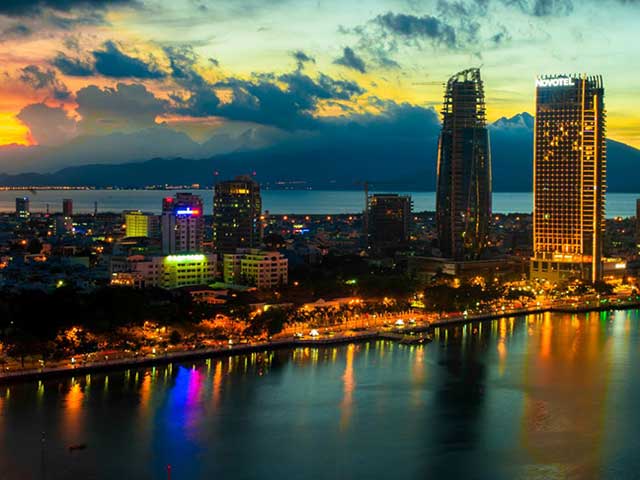
Halong Bay, Vietnam

Halong bay, Vietnam

Ha Long Bay is a UNESCO World Heritage Site, and a popular travel destination, located in Quang Ninh province, Vietnam. Administratively, the bay belongs to Hạ Long City, Cẩm Phả town, and part of Van Don district

Mt.Phousi, Luang Prabang, Laos

The Phousi Mountain (Luang Prabang)

The Phousi Mountain is situated in the centre of Luang Prabangs. To climb up the mountain can be hard but it is definitely worth the trip. There is a formidable view from the top of the mountain where you can see "The Royal Palace", and the surrounding rivers and villages.

Angkor Wat, Cambodia

Angkor Wat, Cambodia

Angkor Wat is the largest Hindu temple complex and the largest religious monument in the world.

Shwedagon Pagoda, Burma

Shwedagon Pagoda, Burma

The Shwedagon Pagoda officially titled Shwedagon Zedi Daw, also known in English as the Great Dagon Pagoda and the Golden Pagoda, is a 99 metres gilded pagoda and stupa located in Yangon, Burma.

Thien Mu pagoda

Thien Mu pagoda, Vietnam

Thien Mu Pagoda is a historic temple in the city of Huế in Vietnam. Its pagoda has seven storeys and is the tallest in Vietnam.

Showing posts with label Threeland Travel Cambodia. Show all posts

Sep 10, 2012

Top 5 must-do things in Siem Reap

Siem Reap is the gateway to the Angkor temple complex, wherein its centuries-old architecture and art give meaning to Cambodia's tourism campaign "Kingdom of Wonder." Walking the grounds of the temple ruins amid the dense forests and fields will make you feel like Indiana Jones or Lara Croft. But there’s more to Siem Reap than just the temples. Here are some of the essential Siem Reap experiences:


Sunrise at Angkor Wat
From Threeland Travel's Blog - September 2012

No trip to Siem Reap would be complete without seeing the ancient stone city of Angkor. There are hundreds of temples, each with impressive architecture and art. Some temples are better-restored than others, but each has a unique charm.

The most famous of the temples is Angkor Wat. Built in the 12th century, Angkor Wat was built as a temple for the Hindu god Vishnu.

Visit the Angkor Wat at sunrise. The majestic spires are bathed in early morning glow making it a very memorable sight. Going in the early morning is also a good idea to avoid the heavy crowds, especially during the weekend. For a unique experience, go on a balloon ride for an aerial view of the Angkor complex.

Other Angkor temples are no less impressive than the Angkor Wat. In Angkor Thom, Bayon Temple stands in the center of the walled city. It is known as a complex of "face towers," or towers with huge stone faces of Buddha. Ta Prohm, a temple-monastery built in the late 12th to 13th century, is perhaps best known as the location for the "Tomb Raider" movie. There are huge trees growing on top of the temple ruins, giving it an eerie but romantic atmosphere.

Bayon Temple

Bayon Temple
Bayon Temple
From Threeland Travel's Blog - September 2012
Banteay Srei, which means Citadel of Women, has a unique beauty that lives up to its reputation as "Jewel of Khmer Art." The buildings, which were built in the second half of the 10th century are made of red sandstone and decorated with intricate wall carvings.

Your inner Indiana Jones will be unleashed when you go to Beng Melea, located about an hour and a half's drive from downtown Siem Reap. Built in the middle of the 12th century, Beng Melea is still largely unrestored with collapsed towers and galleries. You might find yourself crawling and climbing up large chunks of stone. It can be quite exhausting, but worth the experience.

Going 'amok'

Cambodia's national dish, fish amok (fish curry), is a must try. Usually it is served in banana leaf, but the version we tried was served in a coconut. The curry is lightly spiced but flavorful, and perfect with steamed rice.

Another must try dish is Khmer curry. The red curry might give the impression it is spicy, but it is surprisingly not since the red chili is tempered by the coconut cream.

Cambodian noodle dishes are also quite tasty. Mee ketang is a Cantonese-style noodle dish with wide rice noodles, vegetables, mushrooms in oyster sauce.

Lok lak, stir-fried marinated beef served with a fried egg on a bed of lettuce and tomatoes, was a bit disappointing. The beef wasn't tender and dipping it in a sauce of black pepper, salt and lime juice didn't help. Depending on the restaurant, it can be served with French fries or rice.

Cambodian dish Lok Lak

Khmer food: Lok Lak
Khmer food: Lok Lak
From Threeland Travel's Blog - September 2012
The green mango salad, which has carrots, mango, onion and basil in fish sauce, was a refreshing surprise. The fresh spring rolls, with its raw vegetables, thicker rice paper and not-so-sweet peanut sauce, was bland. Fried spring rolls, with cabbage, carrots and taro, are a much better choice.

Freshly cooked sticky rice with a slice of jackfruit wrapped in banana leaves may remind Filipinos of "suman", but it still has a unique Cambodian flavor.

If you want to try the most Cambodian dishes in one sitting, head to Koulen II restaurant which offers a buffet with Apsara traditional dance show only for $10. If you want to learn how to make Khmer dishes, there are cooking classes offered at Temple, along Pub Street.

Search for Cambodian souvenirs

Tourists can get a feel for a traditional Cambodian market at the Phasar Chas (Old Market). But after a day at the temples, most tourists head to the night market. There are several night markets in Siem Reap, but don't worry about getting lost since there are big flashing signs of "Night Market" everywhere.

The night market offers a wide range of souvenirs, such as T-shirts, keychains, ref magnets, silk scarves, silver accessories and wood carvings. Haggling is a must!

For high quality products, go to Artisans d' Angkor which showcases silk fabrics, stone and wood carvings, silver plating and lacquer items. A social business, Artisans Angkor has helped revive Khmer arts and crafts, as it established workshops that educates and trains young, disadvantaged Cambodians.

The Cambodia Landmine Museum is a reminder of the horrors that landmines have caused in the country. In fact, if you look closely, some of the temples have signs that say the area has been cleared of landmines.

Aki Ra, a former Khmer Rouge child soldier, is at the forefront of de-mining efforts, having established the museum and the NGO Cambodian Self-Help Demining. The museum, a 30-minute tuk tuk ride from downtown Siem Reap, gives visitors a closer look of how landmines work, the destruction it inflicted and what they can do to help rid the world of landmines.

It's a sobering look at Cambodia's past, and gives visitors a sense of just how much suffering Cambodians went through. Visitors can donate to the Museum Relief Center, a shelter for some Cambodian children who were injured or orphaned due to landmines.

Relaxing Khmer-style

After a long day of trekking at the temples and shopping, relax by getting a Khmer massage. There are several places offering massage and reflexology treatments along Pub Street and even in the night market.

There's also several "fish foot massage" stalls, where fish nibble at the dead skin on your feet. It may feel ticklish at first, but you'd be surprised at how clean your feet look after. A 30-minute fish foot massage costs just $3 with a can of Angkor or Cambodia beer.

Visit us at Threeland Travel Cambodia to get further information about traveling around the world and exploring Cambodia; to have access to the best travel services and to meet our professional consultants who're always available for help. For any inquiry please contact us.

Sep 4, 2012

Phnom Penh’s Spotlights

Phnom Penh
Phnom Penh - Cambodia
From Threeland Travel's Blog - September 2012
Far from the gleaming skyscrapers of modern Southeast Asian capitals such as Bangkok or Kuala Lumpur, Cambodia’s capital Phnom Penh is a dusty and edgy yet somewhat enchanting city of crumbling colonial architecture, wide boulevards and chaotic markets.

It is gradually modernizing, with a few contemporary skyscrapers appearing on the skyline and the popular riverside promenade (Sisowath Quay) now lined with lively cafés, juice bars, hostels, hotels and restaurants – many of them filled with backpackers and other travelers. Despite that, however, Phnom Penh still has an edge and atmosphere found in few other Southeast Asian capitals. Some elements of the city are quite charming, such as the ramshackle market stalls and historic temples, while others can prove to be quite the opposite: tiny children gathering recycling from bins to make a few Riel for their family, and amputee beggars vying for tourists’ pockets.

While most visits to the city are trouble-free, always watch your pockets and bags as there is a great deal of poverty in Phnom Penh that gives rise to opportunist theft. At the same time, look after your health by following the usual travel health tips such as avoiding ice in drinks (unless it’s from a trusted source) and always using a good mosquito repellent , particularly from dusk onwards, to protect yourself against malaria and dengue fever.

Dominating the city centre’s sightseeing attractions is the 19th century Royal Palace, including the fabulous Palace Grounds, Silver Pagoda and Temple of the Emerald Buddha. It’s open from 8am, and this is the best time to visit to avoid the heat. You’ll need to wear something decent to cover legs and shoulders, or you can hire a sarong and large t-shirt for a small fee at the entrance.

Cambodia Royal Palace
Royal Palace
From Threeland Travel's Blog - September 2012


Another central sight is the National Museum of Cambodia, which features an interesting collection of art from Cambodia’s ‘Golden Age’ of Angkor, alongside statues of Hindu Gods, ancient inscribed tablets and prehistoric burial artifacts. At its centre there is a lovely courtyard with a statue of Yama, the Hindu god of death (or the ‘Leper King’) taken from the Terrace of the Leper King in Angkor Archaeological Park.

A must-see sight for anyone who wants to better understand Cambodia’s horrific past during the Khmer Rouge’s four-year campaign of terror is the Tuol Sleng Genocide Museum. This school, which was converted into the country’s most notorious prison (‘S21′) in 1975, housed more than 14,000 people who were tortured and then killed and buried at the Killing Fields just outside of the city. Only eight prisoners made it out of the prison alive.

You can hire a taxi or tuk-tuk for the 17km trip out of town to the tranquil yet moving Killing Fields of Choeung Ek. A glass-sided Buddhist stupa containing thousands of human skulls lies at the heart of the mass graves that were discovered in 1979.

Perhaps one of the city’s most bizarre attractions, which commission-earning tuk-tuk drivers will be quick to tell you about and encourage you to visit, is the Thunder Ranch Shooting Range. Situated near the Killing Fields, it is said to be run by a unit of the Royal Cambodian Army, and for a relatively high fee you can try shooting pistols or machine guns at paper targets. Many tuk-tuk drivers will try to include it in a ‘package’ with the Killing Fields, but if you don’t want to go there just make it clear that you’re not interested.

After a hard day’s sightseeing, treat your aching limbs to a massage – there are plenty of spa places around the main tourist areas, prices are cheap, and the massage is generally very relaxing.

Visit us at Threeland Travel Cambodia to get further information about traveling around the world and exploring Cambodia; to have access to the best travel services and to meet our professional consultants who're always available for help. For any inquiry please contact us.

A warm welcome from Threelanders.

(Source: Tours to Cambodia Travel News)

Aug 30, 2012

New border crossing in Preah Vihear

Preah Vihear Temple
Preah Vihear Temple
From Threeland Travel's Blog - August 2012
The Cambodian government is seeking a new international border checkpoint in Preah Vihear province to link with Thailand’s Ubun province, officials say.

Preah Vihear provincial governor Um Mara said officials from both countries had met to examine the possibility of opening a new international checkpoint.

“These days, this gateway is open only two days a week, but we want it to become an international checkpoint that is open every day of the week,” Mara said.

There is no scheduled deadline to open the new international checkpoint, to be named Anses, because discussions are still in the early stages.

“We are preparing the infrastructure there first, but the opening date is unknown at this time,” Mara said.

When the gateway becomes an international checkpoint, it will allow more goods to be transported through, and tourism in the province would soar as a result.

Kong Vibol, director of the Tourism Department in Preah Vihear province, said the Preah Vihear temple was only a 60-kilometre drive from Anses.

Ho Vandy, co-chair of the Tourism Task Force of the Government-Private Forum, said he welcomed the news.

Opening the gateway would open the area up to the tourism industry, as associations have suggested since March, 2008.

Visit us at Threeland Travel Cambodia to get further information about traveling around the world and exploring Cambodia; to have access to the best travel services and to meet our professional consultants who're always available for help. For any inquiry please contact us.

A warm welcome from Threelanders.