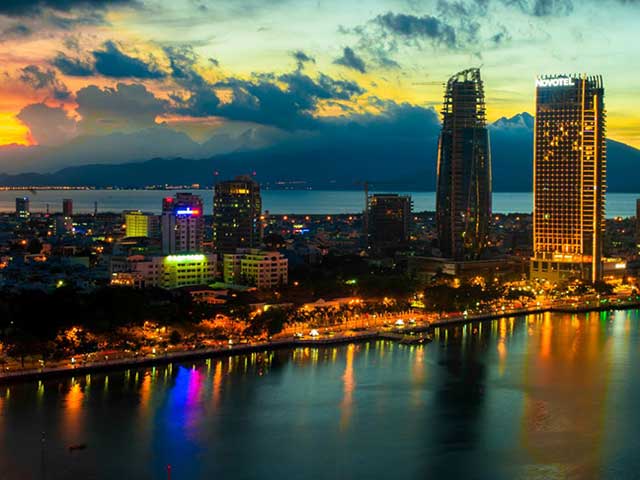
Halong Bay, Vietnam

Halong bay, Vietnam

Ha Long Bay is a UNESCO World Heritage Site, and a popular travel destination, located in Quang Ninh province, Vietnam. Administratively, the bay belongs to Hạ Long City, Cẩm Phả town, and part of Van Don district

Mt.Phousi, Luang Prabang, Laos

The Phousi Mountain (Luang Prabang)

The Phousi Mountain is situated in the centre of Luang Prabangs. To climb up the mountain can be hard but it is definitely worth the trip. There is a formidable view from the top of the mountain where you can see "The Royal Palace", and the surrounding rivers and villages.

Angkor Wat, Cambodia

Angkor Wat, Cambodia

Angkor Wat is the largest Hindu temple complex and the largest religious monument in the world.

Shwedagon Pagoda, Burma

Shwedagon Pagoda, Burma

The Shwedagon Pagoda officially titled Shwedagon Zedi Daw, also known in English as the Great Dagon Pagoda and the Golden Pagoda, is a 99 metres gilded pagoda and stupa located in Yangon, Burma.

Thien Mu pagoda

Thien Mu pagoda, Vietnam

Thien Mu Pagoda is a historic temple in the city of Huế in Vietnam. Its pagoda has seven storeys and is the tallest in Vietnam.

Showing posts with label World Heritage. Show all posts

Oct 4, 2012

ITE highlights latest World Heritage site

Tay Do Citadel
Tay Do Citadel
From Threeland Travel's Blog - October 2012
Recently designated World Heritage site, Vietnam’s Tay Do Citadel was a highlight of promotions at the 8th International Travel Expo 2012 last week.

Located in Thanh Hoa province in north-central Vietnam, Tay Do Citadel gained UNESCO World Heritage status mid-last year.

However, the city still lacks good accommodation, with just a single four-star hotel and three budget properties to serve tourists.

The citadel was inscribed as a UNESCO World Heritage site, 27 June 2011 and became the seventh World Heritage site in the country.

Tay Do Citadel or Citadel of the Ho Dynasty was built in 1397. It comprises an inner citadel, the La Thanh outer wall and the Nam Giao altar on a site of 155.5 hectares, surrounded by a buffer zone of 5078.5 hectares. The inner citadel was constructed of large limestone blocks and is an example of a change in architectural technology of that century.

Chao Vietnam managing director Thuy Le told TTR Weekly that mainly domestic tourists visited Thanh Hoa with just a few international tourists — FIT tourists from India and France take a tour routed HCMC-Nha Trang-Hanoi-Halong Bay-Thanh Hoa-Hanoi, organized by her company.

Thanh Hoa is around 185 km from Hanoi taking about four hours by car and 3.5 hours by train.

As hotel accommodation is still limited, many visitors travel to the citadel and stay in Halong Bay before returning to Hanoi. It is only 65 km from Halong Bay.

According to local media, the Thanh Hoa Provincial People’s Committee plans to upgrade Sao Vang Airport, 45 km from the provincial city for civil aviation at the end of this year. It is currently an air force base.

Thanh Hoa also assigned the Provincial Department of Transport to complete a road to link Highway 47 with the Sao Vang Airport at a cost of VND 120 billion.

Once operational, the airport will enable tour operators to organize trips to the world heritage site.

Beside the citadel, Thanh Hoa is home to the 6 km long Sam Son Beach, Ben En National Park, Pu Loung National Reserve and the ancient temples of Lam Kinh (old capital during the Le Dynasty).

Visit us at Threeland Travel Vietnam to get further information about traveling around the world and exploring Vietnam; to have access to the best travel services and to meet our professional consultants who're always available for help. For any inquiry please contact us.

A warm welcome from Threelanders.

Aug 14, 2012

Master plan focuses on Hanoi’s heritage

Thang Long Imperial Citadel
From Threeland Travel's Blog - August 2012
HANOI, 7 August 2012: The ancient site of Thang Long Imperial Citadel in Hanoi will undergo restoration, while a cultural and historical park will be added to the site, local media reported late last week.

The Hanoi People’s Committee announced, 1 August, a master plan to develop the ancient site of Thang Long Imperial Citadel in Hanoi into a cultural and historical park.

The decision is based on the Prime Minister’s approval last June, to develop the 45,380 sqm site into exhibit zones, archeological digs, green space, support areas and courtyards.

The 1,000-year-old citadel is located in Ba Dinh district and includes an archeological site at 18 Hoang Dieu Street and a wider area that was once part of the citadel’s grounds. The site was unearthed in 2002 and was only recognised as a World Heritage Site by UNESCO in July 2010.

The master plan of the citadel zone will cover 45,380sqm, including 13,670sq.m and 3,440sq.m exhibit halls used to display archaeological finds and a miniature replica of the ancient citadel.

Up to 21,200sq.m will be reserved for parks and green space, while research and excavation will continue on the 6,800sq.m archaeological site.

In addition, a tunnel will be built across Hoang Dieu Street to connect the archaeological site with the old citadel area to facilitate tours of the compound as well as to create a link between the site and the National Assembly House which is currently under construction.

According to the Hanoi People’s Committee vice chairwoman, Nguyen Thi Bich Ngoc, the key task is to select the best architectural plan for the zone, complete regulations and specific plans for investment, management, and preservation by the end of this year, while continuing archaeological research at the site and ensuring it is open to visitors.

Following the master plan’s announcement, Hanoi will draw up plans for buildings in the relic site and promote preservation and management of the relics. It is understood that the maximum height of newly built structures at the 18 Hoang Dieu Street site will not exceed 5m, and buildings in general will be limited.

The Imperial Citadel of Thang Long was the cultural complex in Hanoi comprising Thang Long Imperial City during the Ly, Tran, Le dynasties and Hanoi citadel during the Nguyen Dynasty. The remains are roughly where the Hanoi Citadel stands today. The royal palaces and most of the structures in Thang Long were destroyed in the late 19th century, and today the ruins of the Thang Long Imperial City are still being excavated
(Vietnam Travel News)

Jul 13, 2012

Ho Dynasty Citadel to receive World Heritage Status in June

Vietnam Tours, Vietnam Travel - Ho Dynasty Citadel
Ho Dynasty Citadel
From Threeland Travel's Blog - July 2012


Addressing the ceremony, National Assembly Chairman Nguyen Sinh Hung said: “The Ho Dynasty Citadel, a unique military and architectural work, has been preserved by our people for over 600 years. It has been regarded as having prominent global cultural value, and recognized as a world cultural heritage site by the UNESCO.”

The citadel and other world heritage sites of Vietnam help international friends better understand the country and its people, opening up new opportunities for tourism development and culture research, he stressed.

The citadel, located in Vinh Long and Vinh Tien Communes of Vinh Loc District was built in 1397, as ordered by Ho Quy Ly, founder of Ho Dynasty (1400-1407). It measures 870m by 883m and was built within only three months, between January and March of 1937. It is the only one built entirely of stone in Vietnam and remained almost intact through ups and downs in history.

Earlier, the province hosted the consultation meeting of UNESCO national commissions in the Asia-Pacific region from June 15-17 in Thanh Hoa City.

An art program entitled "Ho Dynasty Citadel - the Pride of Vietnam" will be held following the ceremony to honor the historical and cultural value of the citadel.

Many activities were organized to celebrate the event, including a village market, a festival of Ly-Tran dynasty folk games, and a display of objects, photos and articles about the citadel and the Ho Dynasty to promote tourism in the region.

On the occasion, Thanh Hoa province also hosted an International Conference for UNESCO National Committees in Asia-Pacific Countries on June 15-17.

The citadel was built under the reign of King Ho Quy Ly and became the capital of Vietnam from 1397 to 1407.

According to estimations, about 25,000cu.m of stone was used to build the walls of the citadel, and each stone had an average weight of 10-20 tonnes.

On account of its unique architectural and historical values, it was recognized as a World Culture Heritage by UNESCO on June 27, 2011.

(Source: Asia Travel Tips)