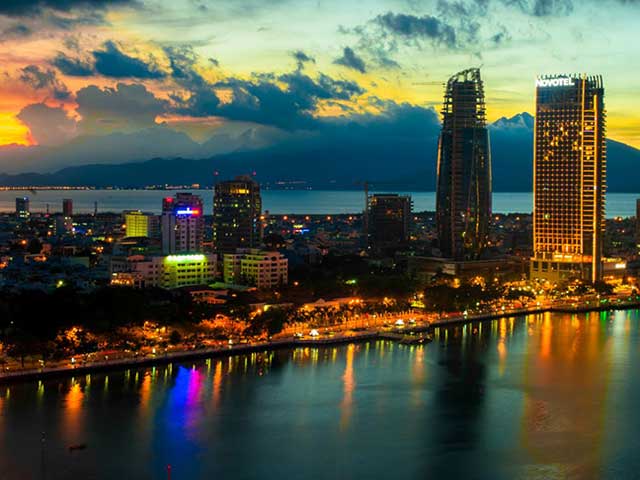
Halong Bay, Vietnam

Halong bay, Vietnam

Ha Long Bay is a UNESCO World Heritage Site, and a popular travel destination, located in Quang Ninh province, Vietnam. Administratively, the bay belongs to Hạ Long City, Cẩm Phả town, and part of Van Don district

Mt.Phousi, Luang Prabang, Laos

The Phousi Mountain (Luang Prabang)

The Phousi Mountain is situated in the centre of Luang Prabangs. To climb up the mountain can be hard but it is definitely worth the trip. There is a formidable view from the top of the mountain where you can see "The Royal Palace", and the surrounding rivers and villages.

Angkor Wat, Cambodia

Angkor Wat, Cambodia

Angkor Wat is the largest Hindu temple complex and the largest religious monument in the world.

Shwedagon Pagoda, Burma

Shwedagon Pagoda, Burma

The Shwedagon Pagoda officially titled Shwedagon Zedi Daw, also known in English as the Great Dagon Pagoda and the Golden Pagoda, is a 99 metres gilded pagoda and stupa located in Yangon, Burma.

Thien Mu pagoda

Thien Mu pagoda, Vietnam

Thien Mu Pagoda is a historic temple in the city of Huế in Vietnam. Its pagoda has seven storeys and is the tallest in Vietnam.

Showing posts with label Luang Prabang. Show all posts

Mar 21, 2015

Luang Prabang celebrates World heritage


At Luang Prabang, on 12 March 2015: A Luang Prabang gives plan is outlined to celebrate its 20th anniversary of its World Heritage Site listing by UNESCO this December.

Vientiane Times informed an official celebration will take place in Luang Prabang 7 to 9 December to mark the anniversary.

Activities in event will include seminars on the protection, conservation and development of the town as a World Heritage Site, as well as meetings and a public parade, photo exhibition, and drawing contest for young people.

These events will concerntrate on Luang Prabang and its role as the country’s top tourist destination while supporting handicraft sales, as well as cultural performances and sports.

The highlights of the event will be an elephant parade led by a white elephant. According to Khampheng Xaysompheng- Luang Prabang provincial governor, the event will showcase the achievements of Luang Prabang in protecting, preserving as well as developing the town to ensure its value is maintained since it was listed as a World Heritage Site in 1995.

The economy of province is growing at an average of 8.2% per year, and average income per person per year is USD 1, 450.

The town authorities realize the worth of tourism in terms of revenue and job creation, but they need to recognise that a very high level of stewardship is required to ensure the next generation can enjoy Luang Prabang’s heritage.

Luang Prabang capital is located on a peninsula formed by the Mekong and Nam Khan rivers and mountain ranges, namely the Phou Thao and Phou Nang ranges that encircle the city.

It was known as Meuang Xua, then Xieng Thong and from the 14th to 16th centuries the town became the capital of the powerful Kingdom of Lane Xang (Kingdom of a Million Elephants). Probably, it dates back more than 1,200 years.


But Luang Prabang attracted the imagination of travellers because of the fusion of traditional and French colonial architecture during the 19th and 20th centuries and its chill-out ambience that still survives despite a tourism boom. In Asia, it is one of the few remaining towns that reflect a blending of two distinct cultural traditions.

Nov 28, 2012

Festival season in Luang Prabang

Luang Prabang Film Festival
From Threeland Travel's Blog - November 2012
Films and handicrafts are the themes of two festivals that will add variety to Luang Prabang’s tourist attractions this December.

Usually considered the region’s chill-out town even at the height of its tourist season in December, authorities are hoping the 3rd Luang Prabang Film Festival scheduled 1 to 5 December, will add entertainment value.

Films will be shown at three venues starting from 1000 at a site near the central market plaza, Amantaka Hotel and LPFF visitor centre, free of charge.

The festival features Southeast Asian productions including short documentaries, as well as exhibitions, seminars, workshops and concerts. This year, there are films from all ASEAN member countries.

The titles have been selected by the festival’s Motion Picture Ambassadors (MPAs) to represent the best films produced in the region over the past five years.

Following on from the film festival, the Luang Prabang Handicraft Festival will be hosted 7 to 11 December at the Hong Xaek (behind the Tourist Information Centre).

Apart from showcasing handicrafts from around the country, the event will introduce the label, “Handmade in Luang Prabang” as a seal of an original handicraft locally made. There will also be product contests, handicraft demonstrations and cultural shows. Admission is free.

Threeland Travel Laos provides interesting Laos tours for your Laos vacations and Laos holidays. Check out Laos travel to unwind yourself. Please contact us for further information and instant advice.

Nov 9, 2012

Absolute Hotel Services Signs Hotel in Luang Prabang, Laos

Luang Prabang, Laos
Luang Prabang, Laos
From Threeland Travel's Blog - November 2012
Absolute Hotel Services has signed a new U Hotel.

Scheduled to open in 2014, the 50-room U Luang Prabang sits on a peninsula of the Mekong River from which guests can enjoy the of the mighty river, mountains and sunsets.

The overall design of the resort will be in an authentic Luang Prabang style with modern influences. The facilities will include a specialty restaurant, a library/lounge, a gym, spa facilities, a river terrace and swimming pool.

U Luang Prabang will also have access via a walking bridge directly to the old town just 50 meters away.

“We are delighted to announce our first U property in Laos and especially located in the iconic town of Luang Prabang, a UNESCO site. With the U Hotels & Resorts brand now represented in Thailand, India, Indonesia, Vietnam and Laos the destination coverage for our U guests is growing at a rapid pace. With the U Luang Prabang enjoying such an amazing location on the banks of the Mekong River we are assured of yet another inspired property,” said Jonathan Wigley, CEO of Absolute Hotel Services Group.

Threeland Travel Laos provides interesting Laos tours for your Laos vacations and Laos holidays. Check out Laos travel to unwind yourself. Please contact us for further information and instant advice.

Sep 27, 2012

Switzerland gives US$6.3m to boost agro-biodiversity

The Swiss Agency for Development and Cooperation
From Threeland Travel's Blog - September 2012
The Swiss Agency for Development and Cooperation (SDC) handed over US$6.3 million in support of the Lao government’s Agro-Biodiversity Initiative (TABI) in Vientiane on Friday.

The SDC has increased its efforts to enhance the livelihood and security of upland farming communities by nurturing the productive use of natural products and the conservation of agro-biodiversity resources.

Ms Ruth Huber and Dr Phouangparisak Pravongviengkham shake hands after the signing ceremony.

It’s the second phase of the initiative, and the money will go towards work in the two northern upland provinces of Luang Prabang and Xieng Khuang.

Switzerland has been a long-term partner of the Ministry of Agriculture and Forestry, SDC Regional Director for the Mekong Region, Ms Ruth Huber, said.

SDC has been working in partnership with the ministry since the early 1990s, supporting a number of important initiatives aimed at improving rural livelihoods and food security, while at the same time conserving natural resources in Laos.

SDC’s activities have always focused on the northern uplands – one of the nation’s poorest regions – and which is now facing unprecedented rapid economic, social, and ecological change.

Ms Huber expressed her support for responsible choices that ensure environmental and ecological foundations are not compromised. “While change itself is inevitable, it is everyone’s responsibility to ensure that the change is one for development that benefits people and leads to an improvement of the locals’ livelihoods.”

Laos is ecologically rich with an abundance of natural resources, but due to population growth, land use changes, government sanctioned land allocation and village consolidation policies, this biodiversity has eroded over the past 10 years. Impoverished upland farming communities have not been beneficiaries of the influx of commercial resource extraction and large scale commercial agriculture projects.

Instead, they face limited access to non-timber forest products, soil degradation, and increasingly scarce water and land.

These threats to agriculture and food security have adverse effects on the population’s livelihoods, in an area where more than 80 percent of the country’s inhabitants live in rural areas and depend mainly on wild plants, forest products and domesticated cro ps.

Laos is a signatory to the International Convention on Biological Diversity. The government has developed a National Biodiversity Strategy and Action Plan to meet its obligations under the convention.

The TABI project contributes to the Lao government’s efforts to apply the Convention and promote agro-biodiversity overall.

TABI is building on the past successes of phase one. In Luang Prabang and Xieng Khuang provinces, project activities have benefited more than 8,000 families that have participated in agro-biodiversity based income and livelihood opportunities developed in 160 villages.

The project installed bio-gas facilities in 20 villages. Land use planning has engaged more than 3,180 households in 34 villages to join in Forest and Land Use Planning activities, covering 220,000 hectares of land.

This has created the groundwork for improved land and forest use and management, for solving land use conflicts, as well as for safeguarding communities against inappropriate land concessions.

Agriculture and Forestry Deputy Minister, Dr Phouangparisak Pravongviengkham, said TABI is very important for Laos because it’s assisting the improvement of community livelihoods in upland areas – and making significant inroads for reducing poverty in the country.

The Swiss Agency for Development and Cooperation is Switzerland’s public agency for social and economic development in developing nations. SDC manages and implements Swiss funding in response to the needs of the rural poor and contributes to the country’s efforts to graduate from the UN’s least developed country list by 2020.

Visit us at Threeland Travel Laos to get further information about traveling around the world and exploring Laos; to have access to the best travel services and to meet our professional consultants who're always available for help. For any inquiry please contact us. A warm welcome from Threelanders.

Jul 18, 2012

The Sacred Wat Wisunalat


wat wisunalat
Wat wisunalat
From Threeland Travel's Blog - July 2012
Wat Wisunalat (Vixoun, Visounnarath, Vixunhalat, Wisunarat) was originally built during the reign of King Wisunarat (or Vixoun, 1501-1520) in 1513 (some suggest 1512) and represents the earliest style, sometimes referred to as Luang Prabang Style I, of Lao temple architecture. This style also includes the Sims of Wat That Luang and Wat Mai. Wat Wisunalat is Luang Prabang’s oldest operating temple. As with the Sims of most Lao Wats, there are multiple roof structures. In the Style I form the first and second roofs extend around the entire perimeter of the structure. Except for the sim at Wat Mai, which was embellished by two additional gable roofs and two roofed side galleries, the style evokes simplicity, since the sim employs neither the high peaks of the gable nor the dramatic low sweeping roofs of many of the other sims of Luang Prabang. Located and adjoining Wat Aham to the southeast, it was probably built on the rice fields of the guardian spirits of the city (devata luang), Pu No and Na No (Phou Nheu and Nha Nheu). The sacred Prabang image was housed in the sim from 1513 until it was taken to Vientiane in 1707.

The original highly ornate wooden sim was a spectacular example of Lao craftsmanship at its finest and was one of the most imposing religious structures of old Luang Prabang. It had a double roof with the upper roof raised high above the lower roof. It was over 118 ft. (36m) long and 59 ft. (18m) wide; perhaps 4,000 trees were used in its construction. Each of the twelve pillars supporting the roof was almost 100 ft. (30 meters) high. There were twenty-one windows with turned wooden balustrades. Louis Delaporte’s engraving of its appearance in the 1860s is included in the series of photographs that follow on this site and shows the unique character of the sim. Most of the partitions of the original building were carved wood, and the exterior, as portrayed in the engraving, made it one of the most beautiful in Luang Prabang. It also housed a major collection of rich religious objects and other objects d’art. Much of the sim and the city were destroyed during the invasion of the Chinese Haw Black Flags marauders in 1887.

The sim was rebuilt between 1896 and 1898 and during the reign of King Sakkarin Kamsuk (r. 1894-1903). The style was somewhat to the old sim with its numerous massive wooden beams, window placement and style of the roof, albeit the major part of the structure was brick and plaster in place of the wood. The window balustrades attempt to capture the flavor of the older turned wooden balustrades of the original sim. The sim today continues its existence as a valuable of museum religious art with numerous centuries’ old Buddha statues in bronze and gilded and unadorned wood, ordination precinct stones and other religious objects.

Another important and prominent feature of the wat is its unique That Pathoum, or Stupa of the Great Lotus, in the front and northeastern side of the sim. It is known more popularly as That Makmo, the “Watermelon Stupa” because of its rounded dome. The dome stylistically reflects a Sinhalese influence and is the only stupa of such a shape in Laos, and perhaps even in Cambodia or Vietnam. Originally erected between 1514 and 1515, it was destroyed during the Haw Black Flag incursion in 1887. Inside were numerous ancient Buddha images. Many were destroyed; a number are in the National Palace Museum, and some are in the sim itself. Its reconstruction was not seriously undertaken until the late 1920s, over thirty years after the reconstruction of the sim, and was completed in 1932. The stupa sets on a number of different square tiers and has a Lao-Buddhist style Usnisa crown at its top.

To celebrate Year Laos 2012, many historical architectures and tourism sites are restored to welcome visitors. If you have any interest in this field, please visit Threeland Travel Indochina and contact us to receive instant advice.
(Source: Asian Historical Architecture)