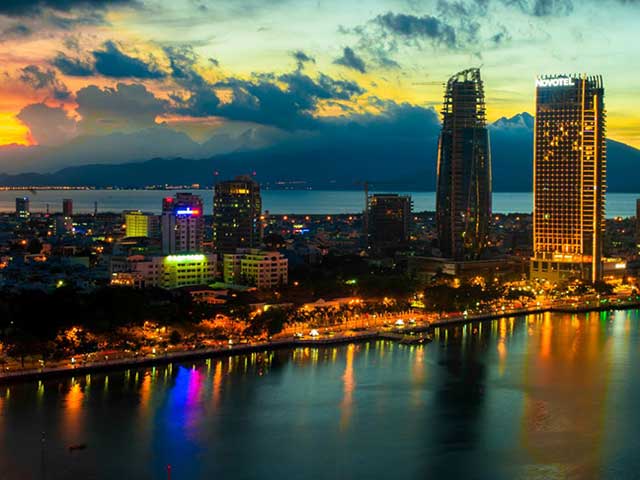
Halong Bay, Vietnam

Halong bay, Vietnam

Ha Long Bay is a UNESCO World Heritage Site, and a popular travel destination, located in Quang Ninh province, Vietnam. Administratively, the bay belongs to Hạ Long City, Cẩm Phả town, and part of Van Don district

Mt.Phousi, Luang Prabang, Laos

The Phousi Mountain (Luang Prabang)

The Phousi Mountain is situated in the centre of Luang Prabangs. To climb up the mountain can be hard but it is definitely worth the trip. There is a formidable view from the top of the mountain where you can see "The Royal Palace", and the surrounding rivers and villages.

Angkor Wat, Cambodia

Angkor Wat, Cambodia

Angkor Wat is the largest Hindu temple complex and the largest religious monument in the world.

Shwedagon Pagoda, Burma

Shwedagon Pagoda, Burma

The Shwedagon Pagoda officially titled Shwedagon Zedi Daw, also known in English as the Great Dagon Pagoda and the Golden Pagoda, is a 99 metres gilded pagoda and stupa located in Yangon, Burma.

Thien Mu pagoda

Thien Mu pagoda, Vietnam

Thien Mu Pagoda is a historic temple in the city of Huế in Vietnam. Its pagoda has seven storeys and is the tallest in Vietnam.

Showing posts with label easier visa. Show all posts

Aug 22, 2014

Official E-visa for Tourists by Myanmar from September

From September 1st, Myanmar will propose e-visa for tourists landing at Yangon International Airport. A welcome simplification as the rise in tourism could not be matched by consular agencies...


After a first short attempt in 2010 and the possibility to obtain a visa on arrival for people officially invited by the Government, Myanmar will offer from September 1st the possibility to get an online visa for tourists arriving exclusively at Yangon International Airport. The information was confirmed mid-August by Myanmar Ministry of Immigration and Population. Once the e-visa procedures for tourists start to run smoothly, authorities expect to extend the facility to business visas.

Tourists will need to file their application on the Ministry of Immigration and Population’s website. It will take approximately five open weekdays for the ministry to check out the visa application. Once it has been approved, the ministry will send an official confirmation that the traveler will have to proceed with their travel arrangement to the country.

Once at Yangon International Airport, the visitor will show the print letter of confirmation and have his visa issued. The cost of the e-visa is fixed at US$ 50. However, authorities will still have the right to refuse the entry despite the e-visa approval. The visa will have to be used within three months of approval and will be valid for 28 days. It will be available to all nationalities.

The simplification of visa procedure is likely to further boost total arrivals to the country. Myanmar expects to reach three million foreign arrivals this year and targets seven million of arrivals in 2020. Tourism revenues could reach this year over a billion dollars for the first time of the country's tourism history.

Aug 7, 2014

Vietnam Visa Exemptions For More International Visitors

Vietnam National Administration of Tourism will propose more visa exemptions to the authorities for visitors from certain markets in North America, Europe, Taiwan, Hong Kong and Australia, while extending the visa-free duration for other markets to attract more foreign travelers to Vietnam.

The proposal was forwarded to VNAT after a meeting between representatives of local tourism and trade agencies, tour operators, transport companies, big hotels and the European Chamber of Commerce in Vietnam (EuroCham) in Hanoi, 10 July.
At the meeting, experts said visa exemptions were limited and needed to be widened to include more countries to boost tourism.
The meeting noted that even the visa-on-arrival facility was complicated and required travelers to complete some advance paperwork to ensure it worked properly.
It is also likely that Vietnam will increase the visa-free stay from 15 to 30 days for citizens from Denmark, Sweden, Finland, Norway, Russia, Japan and South Korea.
VNAT has also urged the government to streamline visa-on-arrival procedures and introduce electronic visas.
Similar changes were also suggested by the Tourism Working Group under the Vietnam Business Forum at a mid-term dialogue between the government and the business community in Hanoi last month.
Vietnam already allows nationals of 17 countries to enter the country without a visa. The length of stay differs.
Citizens of Cambodia, Indonesia, Laos, Malaysia, Singapore, Thailand and Kyrgyzstan get a visa-free stay of up to 30 days. Citizens of the Philippines get 21 days. Citizens of Brunei and Myanmar get 14 days.
Citizens of Denmark, Finland, Norway, Sweden, Russia, Japan, and South Korea get 15 days.
All travelers can visit Phu Quoc for 30 days without a visa, but they must, either enter through the island’s seaport, or through its airport after transiting through Hanoi or Ho Chi Minh City’s international airports.

Apr 3, 2014

Easier visa to Vietnam

Foreign travelers can now complete the visa application process for Vietnam at http://visa.mofa.gov.vn doing away with the need to get forms from the nearest Vietnamese representative agencies around the world.
The website is in four languages (Vietnamese, English, German, and French) and was launched by the Ministry of Foreign Affairs, 14 March.


Vietnamese who travel on a foreign passport (mostly US citizens) can also use the service.

It is part of a serious upgrade of the ministry’s services related to tourists that included improvements to its database, more accurate monitoring and a website to process visas.

The visa applications are scrutinized by the MOFA’s network, as well as other government agencies involved in security before the application is approved.

World Bank grants have supported the project.

Deputy Prime Minister and Foreign Affairs Minister Pham Binh Minh said it showed the MOFA’s resolve to employ IT to streamline visa processes.

“The convenience of an online visa will help to attract more foreign individuals and businesses to visit the country, contributing to our economic development beyond tourism.”

World Bank country director for Vietnam, Victoria Kwakwa, said the online visa application system will help shorten the visa issuing duration to just two working days.


In 2013, international tourist arrivals to Vietnam reached 7,572,352 growing 10.6% from 2012.
Visit us at http://www.threeland.com/ to get further information about traveling around the world and Vietnam holidays 2014; to have access to the best travel services and to meet our professional consultants who're always available for help. For any inquiry please contact us.
A warm welcome from Threelanders.

Jan 29, 2014

ASEAN Considers Single Visa

ASEAN’s may have embarked on a mission to establish a so-called “common visa”, but there is still a considerable distance to cover to make it a reality, according to assessments made during tourism minsters’ press briefing Monday.


It warranted a mention in the minsters’ progress report, outlined at a media briefing, but only to say ministers were “working closely with relevant agencies on the development of a common visa for non-ASEAN nationals and its possible implications on tourism.”

Relevant agencies in this instance are immigration bureaus, national security and police. Ministers admitted privately there are still considerable hurdles to overcome to turn it into a reality.

The subject gains an airing at the annual ATF usually in the minsters’ report card on activities and discussions that confirm it is still on the radar, although not an urgent must-do project before the ASEAN Economic Community kicks in 2015.

On the sidelines of the ministers press briefing, Monday, Indonesia’s minister of tourism and creative economy, Dr Mari Elka Pangestu, said 2014 would see Myanmar sign off on visa free entry for all ASEAN member-country citizens. It is the last of the 10 countries to introduce visa-free travel for the region’s citizens.

“That will be significant progress, we are not sure when Myanmar will complete bilateral agreements on visa-free travel, but we have been assured it will happen before ATF 2015.”

Myanmar has signed bilateral agreements on visa-free travel with Brunei, Laos, Cambodia, Philippines and Vietnam. Thailand was supposed to be next, but Thai caretaker prime minister, Yingluck Shinawatra, postponed her trip to Myanmar last November when she was scheduled to sign off on the agreement.

In addition, it is understood that Myanmar has still to negotiate bilateral agreements on visa-free travel with Singapore, Malaysia and Indonesia.

“Once that process has been completed,” Indonesia’s tourism minister explained, “the next logical step would be to look closely at the Thailand-Cambodia single visa project that is now a pilot project… it could be extended to five of the six Mekong Region countries that all members of ASEAN.”

If that project could be extended smoothly to include all five Mekong Region countries to offer a single visa for non-ASEAN nationalities, the minister believed it would become a sound platform to build an ASEAN-wide common visa.

Visit us at http://www.threeland.com/ to get further information about traveling around the world and Vietnam holidays 2014; to have access to the best travel services and to meet our professional consultants who're always available for help. For any inquiry please contact us.

A warm welcome from Threelanders.

Dec 23, 2013

Easy Visa Between Myanmar and Cambodia

The visa exemption agreement was signed by Myanmar Deputy Foreign Minister U Tin Oo Lwin and Cambodian Ambassador to Myanmar Sieng Burvuthin.


Myanmar and Cambodia have agreed on mutual visa exemption for ordinary passport holders to simplify the procedures of citizens’ travelling and strengthening existing friendly ties.

The agreement was signed by Myanmar Deputy Foreign Minister U Tin Oo Lwin and Cambodian Ambassador to Myanmar Sieng Burvuthin.

Earlier, Myanmar Airways International (MAI) opened an air route between Yangon city and the Cambodia ancient city of Siem Reap in February 2011. The service was extended to reach the Cambodian capital city of Phnom Penh in November that year, helping foster the two countries’ links in tourism, culture, trade and investment.


In another development, Myanmar’s House of Representatives Speaker Thura U Shwe Mann will lead a delegation to Cambodia from December 19-22 to beef up bilateral ties.

Visit us at http://www.threeland.com/ to get further information about traveling around the world and Vietnam holidays 2014; to have access to the best travel services and to meet our professional consultants who're always available for help. For any inquiry please contact us.
A warm welcome from Threelanders.

Nov 11, 2013

Myanmar Visa Exemption To Be Speeded

Myanmar’s government says it hopes to secure bilateral visa exemption agreements with all ASEAN member countries by the end of this year to enable citizens to enjoy visa-free travel for up to 14 days.


Ministry of Foreign Affairs deputy chief administrator, U Sein Oo, was quoted by local media as saying agreements were needed to enable as many people as possible to attend the Southeast Asian Games that will be held mid-December.
However, with just four weeks to go it will be difficult to reach that goal. The Thai premier is expected to sign a bilateral agreement during her official visit linked to  the opening of the Games.
The country already has vias-free travel privileges with Vietnam.
“The government wants to have visa-free travel for all ASEAN nations in 2014, when Myanmar will chair the 10-nation group,” he said.
Yet some countries are still working on the terms, while Singapore and Brunei have not yet responded to proposals according to reliable sources in Yangon.
Agreements with Laos and Indonesia are already at the stage of signing and could be firmed up by the start of the Games. That would leave agreements with Singapore, Malaysia, Brunei, Philippines and Cambodia still to negotiate.
The Union Myanmar Travel Association representative, U Naung Naung Han, said visa-free travel would present a substantial business opportunity for both inbound and outbound travel.
On 22 October, the Thai Cabinet approved a draft agreement on visa exemption but it still needs to be signed by the two premiers.
Once the bilateral accord is signed the visa exemption will apply to departures and arrivals at 23 airports in Thailand.
The airports are: Suvarnabhumi; Don Mueang; Chiang Mai; Chiang Rai; Hat Yai; Phuket; Nan; Phitsanulok; Mae Sot; Mae Hong Son; Khon Kaen; Nakhon Ratchasima; Udon Thani; Ubon Ratchathani; Krabi; Trang; Narathiwat; Ranong; Surat Thani; Hua Hin; Samui; Sukhothai; and U-tapao.
The agreement could also be suspended for security and public health reasons by informing the other country at least 15 days in advance. It can be annulled by either country through a notice presented through diplomatic channels at least 60 days in advance.
Visit us at http://www.threeland.com/ to get further information about traveling around the world and Vietnam tours; to have access to the best travel services and to meet our professional consultants who're always available for help. For any inquiry please contact us.
A warm welcome from Threelanders.

Nov 5, 2013

Visa-free Travel To Myanmar For Thailand

Thai government spokesman, Teerat Ratanasevi, says Thailand and Myanmar will sign an agreement on visa exemption between the two countries, this December,which will give citizens of the two countries a 14-day visa-free stay.


Mr Teerarat said the Cabinet on Tuesday approved the draft agreement on the visa exemption.
“The draft will now be presented to the premiers of the two countries to sign when Prime Minister Yingluck Shinawatra visits Myanmar this December.”
The Thai PM will visit Myanmar, 11 and 12 December, to participate in the SEA Games opening ceremony.
He added: “The draft agreement was submitted to the Cabinet for approval in line with Article 190 of the Constitution, but does not have to be approved by Parliament.”
Under ASEAN membership rules all 10 countries are supposed to allow visa-free travel for the group’s citizens. Myanmar is the last of the member countries to comply with the rule.
However, ASEAN rules are based on voluntary participation and in the case of visa-free travel, bilateral agreements need to be ratified first that comply with national immigration laws.
Once the bilateral accord is signed the visa exemption will apply to departures and arrivals at 23 airports in Thailand.
The airports are: Suvarnabhumi; Don Mueang; Chiang Mai; Chiang Rai; Hat Yai; Phuket; Nan; Phitsanulok; Mae Sot; Mae Hong Son; Khon Kaen; Nakhon Ratchasima; Udon Thani; Ubon Ratchathani; Krabi; Trang; Narathiwat; Ranong; Surat Thani; Hua Hin; Samui; Sukhothai; and U-tapao.
Airports in Myanmar have yet to be identified.
However, the two countries reserve the right to deny entry to certain citizens, or reduce their stay without having to inform them of the reasons, he said.
The spokesman cited that the agreement could also be suspended for security and public health reasons by informing the other country at least 15 days in advance. It can be annulled by either country through a notice presented through diplomatic channels at least 60 days in advance.
Earlier this month, Myanmar’s Foreign Minister U Wunna Maung Lwin and Vietnamese Foreign Minister Pham Binh Minh signed a bilateral agreement in New York to allow Vietnamese travellers, the first in ASEAN, to gain visa-free entry to Myanmar.
Visa-free travel between the two countries applied 26 October this year.
According to the visa exemption pact between Vietnam and Myanmar, citizens need to have passports valid for a minimum of six months, and their stay must not exceed 14 days, without any facility to extend.
Myanmar authorities have also granted pre-arranged visa-on-arrival for visitors from 48 countries. It requires pre-approval from authorities. Once the traveller has confirmation that the visa on arrival has been approved they take a flight to Yangon and have the visa stamped into their passport on arrival.
The visa-free entry between Thailand and Myanmar will be limited to airline travel only, which excludes travellers who might want to travel over the border at Mae Sai in Chiang Rai province and then fly from Tachilek airport to Yangon, Mandalay or Bagan. They will still need a visa to pass through the overland checkpoint.
Visit us at http://www.threeland.com/ to get further information about traveling around the world and Vietnam holidays; to have access to the best travel services and to meet our professional consultants who're always available for help. For any inquiry please contact us.
A warm welcome from Threelanders.

Oct 15, 2013

China - Thailand Take Advantage From Visa Exemption

With visa exemption, it would be much easier, cheaper, as well as time saving for Chinese tourists to travel to Thailand, Li told the Chinese travellers.

Proposed visa exemption for regular passport holders will offer Chinese and Thai tourists more convenience, and promote closer bilateral people-to-people exchanges, Chinese Premier Li Keqiang said on Saturday, according to Xinhua.


Chattering with Chinese tourists in the Thai capital, Li, currently on an official visit to the country, asked about their tourism experiences in Thailand and talked about the visa exemption initiative.

Thailand is the first country within the Association of Southeast Asian Nations (ASEAN) to start such talks with China.

The move was first announced by the Chinese premier when he addressed the Thai Parliament on Friday shortly after his arrival in the Southeast Asian country.

Li said in his speech that visa exemption would facilitate the people-to-people and cultural exchanges of the two countries, and bring more benefits to the two peoples.

China is now the largest source of foreign visitors to Thailand, with Chinese visitors to the country topping 2.8 million person-times last year.

After visiting Bangkok, Li, accompanied by Thai Prime Minister Yingluck Shinawatra, visited the site of Royal Flora Expo in the northern Thai resort city of Chiang Mai.

Touring the the "Chinese Tang Garden", donated by China to Thailand during the expo, he said it embodies cultural exchanges between the two nations and bears witness to the bilateral friendship.

Li called for enhancing people-to-people exchanges between the two nations and promote the amity between the two peoples.
Visit us at http://www.threeland.com/ to get further information about traveling around the world and Vietnam holidays; to have access to the best travel services and to meet our professional consultants who're always available for help. For any inquiry please contact us.
A warm welcome from Threelanders.

Oct 7, 2013

Greater Mekong Subregion Single-visa Plan Steps Forward

The reality of a single-visa for visitors to the Greater Mekong Subregion (GMS) took a small step towards reality with a forum of public and private sector representatives from the countries concerned vowing to push their governments to speed up implementing the proposal.


Comprising Thailand, China (specifically Yunnan Province and the Guangxi Zhuang autonomous region), Burma, Cambodia, Laos and Vietnam, the GMS single-visa proposal is expected to see a significant boost in tourism between member countries, and is a prelude to a wider Asean (Association of Southeast Asian Nations.) plan to include tourists from an additional six non-member countries; Japan, China, South Korea, India, Australia and New Zealand, on a similarly styled single visa.

Though no Asean member has yet adopted the broader plan, Arkhom Termpittayapaisith, secretary-general of the National Economic and Social Development Board, said his agency will raise the Asean single-visa issue at a session of the Committee on Economic Cooperation with neighbouring countries later this month.

While it is unlikely that all six nations comprising the GMS will be in a position to implement the single-visa plan concurrently, Chiang Rai Chamber of Commerce has suggested those that were could go ahead first, acting as trail blazers on the advanced implementation of the scheme.

Highway R3 connecting Kunming, Laos and Thailand has been completed in preparation of the implementation of the GMS one-visa proposal, while the Chinese government is paying half the cost of constructing a fourth bridge across the Mekong River, between Chiang Khong in Chiang Rai Province and Huay Xai in Lao, which will be completed next year.

Tourist arrivals by land are poised to soar once more immigration facilities can be set up, especially for Chinese visitors, with the UN World Tourism Organization (UNWTO) estimating China will be the world’s fourth largest source of outbound tourists by 2020, accounting for 100 million visitors.

UNWTO said East Asian arrivals in Thailand grew by 11.4 per cent to 4.41 million last year, with the number of Chinese visitors rising by 44 per cent to 1.12 million.

According to Mr. Arkhom, GMS countries understand tourism’s potential and have been improving facilities to attract more visitors to places such as Luang Prabang, Laos, a Unesco World Heritage site, with the city upgrading its airport to accommodate Boeing 737s and improving the highway between Thailand’s Nan Province and Jinghong city in China.
Visit us at http://www.threeland.com/ to get further information about traveling around the world and Vietnam tours; to have access to the best travel services and to meet our professional consultants who're always available for help. For any inquiry please contact us.

A warm welcome from Threelanders.
 

Aug 8, 2013

Mutual visa-free between China and Thailand in September

According to “Thai World Journal”, negotiations have been undertaken between Thailand and China to introduce mutual visa-free policy in September this year.


The report pointed out that Thai Prime Minister Yingluck Shinawatra highly welcomed this mutual visa-free policy between Thailand and China, hoping to attract five million Chinese tourists every year. She also indicated that related departments in Thailand should further intensify the activities of sister cities with Chinese counterparts to promote trading and investing.

Representatives of Thai-Chinese Culture and Economy Association had met with Yingluck recently, reporting current progress in promoting and developing cultural and economic cooperation with China. They said that related departments from two countries have already exchanged views on introducing mutual visa-free policy and further details were currently under discussion. This initiative was affirmed and approved by the Prime Minister, who spoke highly of this policy in creating enormous opportunities for both countries.


Once the mutual visa-free policy is implemented, there will be more Chinese tourists visiting Thailand. According to statistics, there are approximately 2 million Chinese travelling to Thailand each year at present, the number of which will increase by 3 to 4 million with the help of the new policy.

Visit us at Threeland Travel Vietnam to get further information about traveling around the world and Vietnam holidays; to have access to the best travel services and to meet our professional consultants who're always available for help. For any inquiry please contact us.
A warm welcome from Threelanders.

Jul 4, 2013

Advantages of Japan visa-free for Thais

Kasikorn Research Centre says Japan visa exemption for Thais will encourage outbound travel to reach around 300,000 trips this year up around 50% on last year’s trends.


Japan confirmed that the new visa-free rule would be effective, 1 July, giving Thai visitors a stay of up to 15 days in the country. For longer stays visitors will need to apply for a visa at the Japanese embassy in Bangkok. The visa-free stay is not extendable.

The bank noted that Japan’s tourism has made a quick recovery in the aftermath of the great East Japan earthquake disaster of March 2011, and through the introduction of visa-free entry, travel to the country should continue to expand.

The centre said the Japanese government intends to increase international tourist arrivals to 18 million by 2016 and 25 million by 2020, focusing on ASEAN markets including Thailand.

Outbound travel from Thailand performs well below par when compared to Singapore and Malaysia. Thais face considerable hassle to obtain visas, while the low value of the Thai baht compared with most currencies in the past made overseas travel expensive.

Japan will give visa-free entry to both Thai and Malaysian tourists. The government of Prime Minister Shinzo Abe approved the scheme, 11 June, although he did not elaborate at the time when the new measure would take effect. He suggested it would be introduced ahead of the summer season. A 1 July launch has now been officially confirmed by the Japanese government.

Other factors that attract foreign visitors to Japan are the diverse tourism products along with numerous breathtaking natural attractions, fine weather, exotic food and a mix of traditional and high tech lifestyles. The bank noted that Japan should welcome 10 million visitors this year, up 20% year-on -year.

Outbound travel from Thailand is growing mainly because of the rapid rise in the baht against the yen since the fourth quarter of 2012. Japan is viewed as a top shopping destination.

Although the baht is expected to weaken substantially in the second half of this year a visa-free policy when combined with creative packaging by Thai travel agents should maintain a steady moderate growth.
The bank estimated Thai travelers will spend around Bt12 billion on trips to Japan this year.

Kasikorn Research Centre is a subsidiary company of Kasikorn Bank, which conducts tourism and business research mainly on Thailand’s economy including tourism with reliable recommendations and indicators on business prospects.

Visit us at Threeland Travel Vietnam to get further information about traveling around the world and Vietnam  tour; to have access to the best travel services and to meet our professional consultants who're always available for help. For any inquiry please contact us.

A warm welcome from Threelanders.

Jun 25, 2013

Vietnam Gaining Visa-free Travel

Tourism expert continue to present the case for visa-free travel to the national government claiming it is essential to build the economy, revenue and jobs in tourism.


They are lobbying to stop a Ministry of Foreign Affairs’ proposal to close the visa-free scheme particularly for seven countries.
Vietnam has in place a pilot visa exemption programme for tourists from Japan, South Korea, Russia, Sweden, Norway, Denmark and Finland. It has been running for eight years for some of the countries, but has met resistance from the country’s Ministry of Foreign Affairs. Another visa-free stay programme for ASEAN visitors has not been targeted for review.
The ministry bemoans the loss of visa fee collection claiming the losses it incurs make the scheme unviable.
A tourist visa to Vietnam currently costs US$45 and if the exemption programme continues the ministry loses US$50 million a year in revenue, although tourism experts point out the positive earnings from tourism far outweigh the loss.
They also argue that a visa-free policy saves costs for the ministry, which can reduce its consulate staff payroll at embassies in the seven countries.
Vietnam Tourism Association vice president, Vu The Binh, argues that the loss of visa fees is just a drop in the ocean compared to the huge amount of revenue the tourism sector brings in every year.
Last year, the country attracted approximately 1.5 million visitors from Japan, Korea and Russia. If each visitor spent an average of US$1,500 during their stay, the tourism sector would earn US$2.1 billion and contribute US$210 million in VAT to the State budget.
“While Vietnam may lose several millions from visa exemptions each year, it will gain billions in tourism revenue,” he said.
“We also earn US$210 million in VAT, not to mention the other benefits such as generating more jobs,” he said.
Visit us at Threeland Travel Vietnam to get further information about traveling around the world and Vietnam tours; to have access to the best travel services and to meet our professional consultants who're always available for help. For any inquiry please contact us.

A warm welcome from Threelanders.

Apr 5, 2013

Asia Pacific and the Americas the Most Open Regions for Travelers in Terms of Visas


New UNWTO research on visa facilitation shows that Asia Pacific and the Americas are the most ‘open’ regions in terms of tourist visa requirements.

Data also shows that there has been significant progress on visa facilitation globally in recent years, particularly with the implementation of visa on arrival policies.

Based on a global evaluation of visa requirements, including the implementation of policies that allow for visa on arrival and e-visas, UNWTO findings show that in 2012 Asia and the Americas were the most ‘open’ regions for the entry of tourists.

An average 20% of the world’s population were not required a visa to visit an Asian destination, while 19% could obtain a visa on arrival and 7% an e-visa – 31%, 8% and 1% respectively in the case of the Americas.

 European destinations were the ‘least open’ when comparing the three components of a visa policy (no visa; visa on arrival and e-visas).

Although 21% of the world population was not required a visa to enter Europe for tourism, only 6% were able to apply for a visa on arrival and no e-visa system was in place.

“An overall restrictive visa policy means lost opportunities for economic growth and jobs, which tourism could bring to destinations. Travelers regard visas as a formality which entails a cost. This can be a deterrent to travel if costs - whether monetary or indirect - including distance, wait times and service, exceed a certain threshold,” said UNWTO Secretary-General, Taleb Rifai.

On a global level, in 2012, only 18% of the world’s population were not required a visa at all when travelling for tourism. Destinations around the world requested on average from 63% of the world’s population that they obtain a traditional visa before initiating their international journey. Another 16% was be able to apply for a visa on arrival, while only 2% of the population was allowed to apply for an e-visa.

This new UNWTO research also shows considerable progress towards visa facilitation over recent years: the requirement of a traditional tourism visa went from 77% to 63% of the world’s population between 2008 and 2012, with significant changes over the last two years.

It was also noted that destinations tend to thoroughly review and introduce changes when reviewing their visa policies. Since 2010, 43 destinations clearly facilitated the visa process for citizens of at least 20 countries by changing their visa policies from ‘visa required’ to either ‘no visa required’, ‘visa on arrival’ or e-visa’, directly impacting on 5,080 destination-source market relations.

“Important strides have been made in recent times in terms of visa facilitation as more and more countries understand its implicit economic benefits. We welcome moves by the USA, the European Union and many other countries which have implemented or are looking into implementing more open visa policies. But we cannot ignore that visa procedures still represent an obstacle to tourism growth and we hope that these good examples can be followed by others,” Mr. Rifai added.

Improving visa processes could generate an extra US$ 206 billion in tourism receipts and create as many as 5.1 million additional jobs by 2015 in the G20 economies alone, according to the joint research by UNWTO and the World Travel and Tourism Council (WTTC).

Visit us at Threeland Travel Vietnam to get further information about traveling around the world and Vietnam  vacation; to have access to the best travel services and to meet our professional consultants who're always available for help. For any inquiry please contact us.
A warm welcome from Threelanders.


Jun 21, 2012

ASEAN to make easier visas for tourists

The East Asia Summit on tourism, trade and travel was held in Bangkok, Thailand on May 30, as part of the World Economic Forum on East Asia. The event took place at a time that ASEAN is said to have a lot of potential to develop tourism and travel. Tourism has made a huge contribution to job generation and stimulates economic growth in ASEAN, as estimated about 4.6 percent of the regional GDP.

Indochina Tours, Indochina Travel - World Economic Forum on East Asia
World Economic Forum on East Asia
From Threeland Travel Indochina's Blog - June 2012
In most ASEAN countries, outdated visa procedures have become one of the hinders to tourism development, therefore, one of the main objectives of ASEAN’s Strategic Plan for Tourism during 2011-2015 is to grant a common visa for non-ASEAN arrivals within five years, to create a Schengen type ASEAN visa.  Once this goal is achieved, tourists can travel freely within the Schengen type ASEAN territory.


In February 2012, Thailand and Cambodia started to grant a single visa for non-ASEAN tourists. The region is pursuing several initiatives focused on intra-ASEAN visas and the adoption of e-visas. Cambodia has already implemented an e-visa system while Myanmar started to use the procedure in March this year. This model is currently in the expending process to Laos and Vietnam.

All of these efforts will play a significant role in promoting tourism in ASEAN. Visitors can get easier access to visas and avoid many restrictions in traveling abroad. If you are interested in this substantial reform, please visit Threeland Travel Indochina and contact us.